Hand-built clay sculpture
Also called hand-formed clay, modelled clay object, ceramic maquette, pinched clay figure, unfired clay model
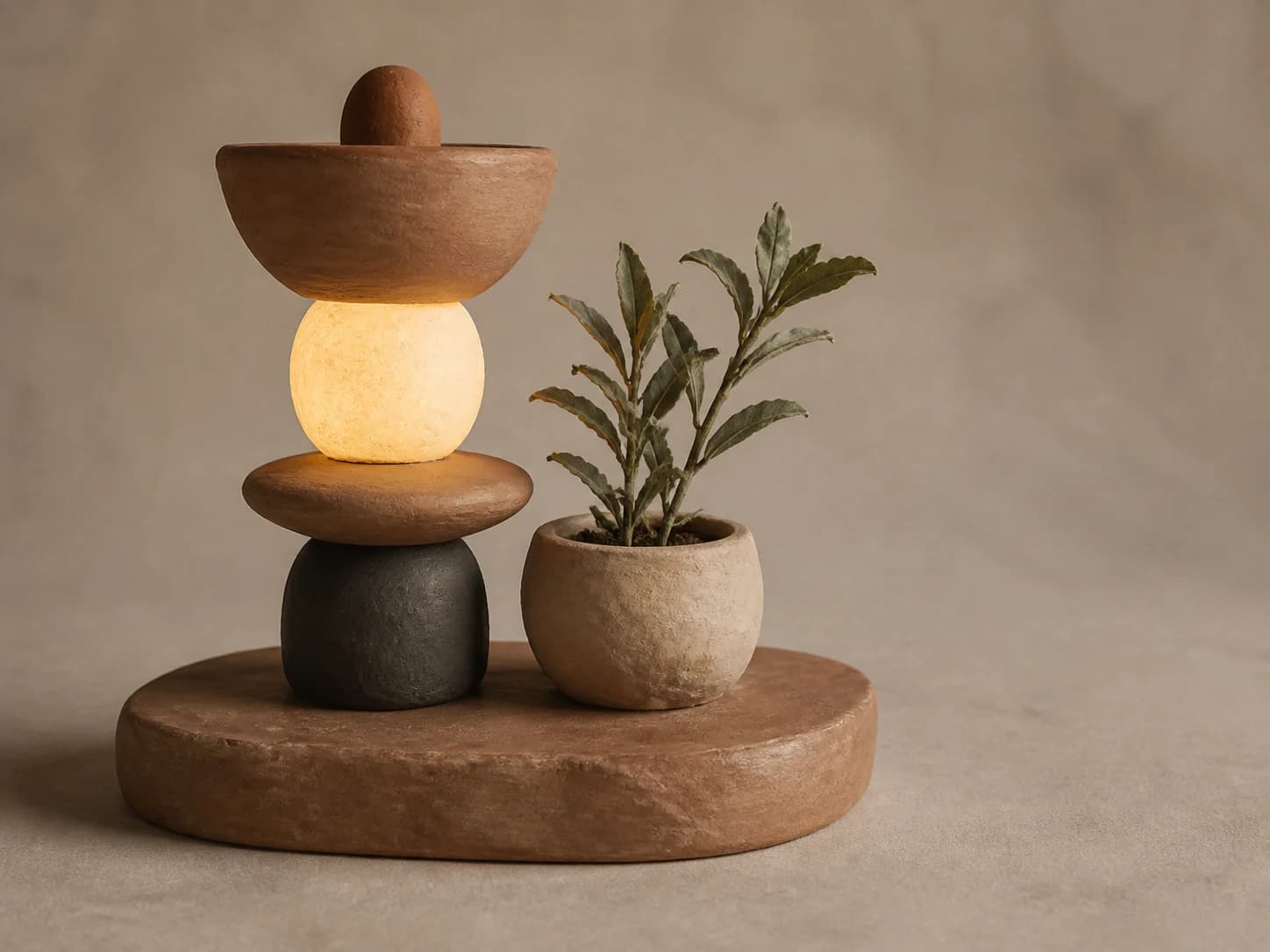
1A real object pinched and pressed by hand, photographed with the fingerprints still in the surface.
Starting from a real product, person, or object? Keep that reference recognizable. Apply the direction to its setting, supporting elements, composition, light, surfaces, crop, and finish instead of redesigning the subject.
- Made by
- Clay formed by hand — pinched, coiled and pressed — then lit and photographed as a real object with the maker's marks left in
- Control
- Prompt + reference — Words get you close; a style reference is what holds a whole set together.
Why it works
What the direction actually buys you when it lands.
- It is a physical object photographed, not a rendering, so the light behaves correctly and the material reads as genuinely present — subsurface softness, real occlusion, real contact.
- Fingerprints and tool marks are the direct evidence of a hand, which converts an abstract brand claim about craft into something visible.
- Clay simplifies form naturally: hand-building cannot hold fine detail, so the object arrives as a confident silhouette that works at any size.
- The matte, low-chroma surface takes on the colour of the light, so a set can be tuned to a brand palette through lighting and clay body rather than through post.
What you see
The perceptual fingerprint — check a candidate against these.
- Visible fingerprints and pressure dents across the surface
- Soft, slightly irregular edges where two pinched forms were joined
- Matte, mineral surface with a slight subsurface softness in the thin sections
- Tool marks — a scraped flat, a wire cut, a smoothed seam — left deliberately unresolved
- Real contact shadow and occlusion where the object meets its surface
Best fit
Where this direction is the right answer.
- Brands whose positioning is craft, material or human-made
- Brand-led hero imagery where an abstract object carries the idea
- Campaign work needing warmth without depicting people
- Mascots and brand objects that should feel handmade rather than designed
Avoid when
Known-bad conditions. Pick another direction instead.
- You need precision, technical credibility or accurate product geometry
- The brand tone is clinical, high-tech or institutional
- The subject needs fine detail — clay cannot hold it and the model will invent it badly
- Anatomical subjects are involved; hand-built clay faces and figures fail badly
Compatibility
How it behaves next to the rest of a design system.
Pairs with
- Humanist sans and soft serif typography
- Warm neutral, sand and terracotta surfaces
- Generous whitespace and single-asset sections
- Kits with soft shadows and generous radius
Tension with
- Neon and high-saturation accent palettes
- Hard geometric linework directions
- Dense technical layouts
- Chrome, glass and gloss treatments
This is a photographed object, so it shares a lighting logic with studio product photography and can sit in the same grid. It does not sit well beside a clay render, which looks similar but has no real material behaviour — the difference is visible and reads as inconsistency.
Accessibility
What has to be true before this ships to real readers.
- Matte clay is low-contrast against neutral backdrops; verify the silhouette separates, and add a background tone rather than a hard outline if it does not
- Keep type off the object entirely — the surface irregularity makes local contrast unpredictable
- Because the palette comes from clay body and light rather than from graphics, this direction sits under most kit palettes without clashing
- Alt text should describe the object and its handmade quality, which is the content
Agent tags
The machine-readable handles an agent matches on when it picks a direction.
- physical-object
- handmade
- tactile
- warm
- photographed
- low-detail
- palette-neutral
Build payload
ProWhat an agent needs to turn Hand-built clay sculpture into a repeatable production brief: prompt scaffold, constraints, parameters and review.